Home › Answered Needs › How do good marriages survive infidelity?
How do good marriages survive infidelity?
Two sentences, and they pull in opposite directions.
The first is a long, quiet wondering: “i've always wondered how good marriages have survived after an instance of infidelity.” Always. Not a passing thought. And the word is good. Not marriages that limp along, but good ones, on the far side of the worst thing a spouse can do.
The second sentence holds two verdicts side by side. One belongs to other people: “Some people say it's doomed to failure.” The other is their own: “but I think through God all things are possible.”
Both verdicts are about the future. Underneath them sit two pairs of things that are easy to treat as one. Pulled apart, they show how the good ones made it.
Forgiven is not the same as restored
“Doomed” usually rests on a picture where forgiveness is the whole job. The betrayed spouse either forgives enough or doesn’t, and if the marriage ends anyway, forgiveness must have failed.
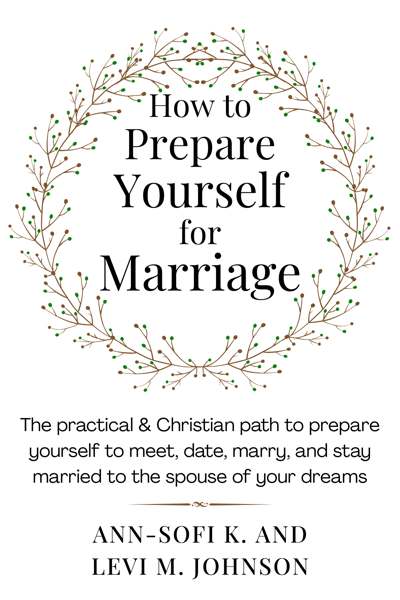
In How to Prepare Yourself for Marriage, in a chapter called “Learn Forgiveness,” Ann-Sofi K. and Levi M. Johnson separate the two:
I also want to note that forgiving someone doesn’t mean that our relationship with them is restored. If it is between you and a safe person who actually wants the best for you and they are the ones who take responsibility, ask for forgiveness, and say that they won’t do that thing again, it is highly likely that they can be trusted, and maybe to an even higher degree than before.
Forgiveness can be given by one person. Restoration needs the other one too. It turns on the person who broke something: taking responsibility, asking, and saying they won’t do it again. A spouse can forgive alone, but nobody can rebuild a marriage alone.
The end of that passage matters: “maybe to an even higher degree than before.” That is one honest answer to a long wondering. Some good marriages are not the ones where nothing happened. They are the ones where something terrible happened, it was fully owned, and trust was rebuilt on more honest ground than it stood on before.
The same book is plain about why so few people get that far:
Asking God who is all good and merciful to forgive you is easy compared to asking a spouse to forgive you for breaking your marital vows. It can be hard enough to forgive ourselves at times, so to need to confess to our spouse and ask them to forgive us can be almost impossible.
“Almost impossible.” The betrayal is one wound. The asking is its own mountain, and restoration waits on the other side of it. Infidelity is a broken vow that is often kept hidden, and the book has a sentence about secrets:
Either way, keeping secrets will always also create division, and that is the opposite of what makes a good and healthy marriage.
A marriage can’t heal a wound that is still hidden. Restoration starts where the secret ends, when the one who broke the vow stands in the light and asks.
Possible is not the same as automatic
“Through God all things are possible.” The book says the same. Writing about habits that feel impossible to break, they put it this way:
The truth is that with God, anything is possible.
“Almost impossible” for the asking, and “anything is possible” with God, in the same chapter. But possible does not mean automatic. Earlier in that chapter they write:
Thanks to Jesus’ sacrifice, there is forgiveness, restoration, and reconciliation for everyone, but it is still a choice. God won’t overstep. He will only intervene if He is invited.
That one word, choice, is where “doomed” and “possible” part ways. “Doomed” says the ending is already written. “Possible” says it isn’t. And if it isn’t written yet, it hangs on choices: one spouse asking, the other forgiving, and both inviting God into the place where the vow broke.
Levi M. Johnson once put the forgiving half without softening it:
Practicing radical forgiveness isn't optional for maintaining and cultivating an enjoyable marriage and interpersonal relationships.
Radical, because this forgiveness reaches the worst thing, not just the small things. Not optional, because a marriage can’t outlast infidelity on forgiveness that stops short of it. The good ones that made it are the ones where forgiveness reached that far, the door stayed open, and both people walked back through it.
So the person who has always wondered, and who thinks all things are possible through God, was already holding the answer. “Possible” was never the opposite of hard. It is the opposite of doomed.
Neighboring pages here: Does covenant marriage extend to self-defense?, Break up or stick it out?, and How do you overcome fear of commitment?
Going deeper
How to Prepare Yourself for Marriage, by Ann-Sofi K. & Levi M. Johnson, is about covenant marriage: a promise bigger than feelings, kept by two people who know how to forgive and be forgiven. On the word “doomed” itself, writing to anyone who has fallen to sexual temptation, they don’t hedge:
Any lies associated with that, like ‘you are doomed because of your mistakes’ are just that, lies! God is mighty to restore as long as we repent, accept His forgiveness, and forgive ourselves.
Forgiven is not the same as restored. Possible is not the same as automatic. Both distinctions were already inside one wondering about how good marriages survive.
If one distinction helped, the book goes further into forgiveness, secrets, and covenant: How to Prepare Yourself for Marriage · Amazon → · Buy the ebook with Bitcoin (Lightning) → · Browse the books →
This page is part of answered needs at FikaTimeBooks.com — real questions, real answers, no squeeze.
Trade your email for the Introduction and Chapter 1 of the book you choose.
You'll receive the Introduction and Chapter 1 of the book you choose, plus occasional emails from FikaTimeBooks.com. Unsubscribe anytime. We never share your email.
Also on marriage: Does covenant marriage extend to self-defense? · Break up or stick it out? · How do you overcome fear of commitment? · More in Marriage: Granular Insights